
SOUND CLASH 91:
Rise Of The #1 Selector

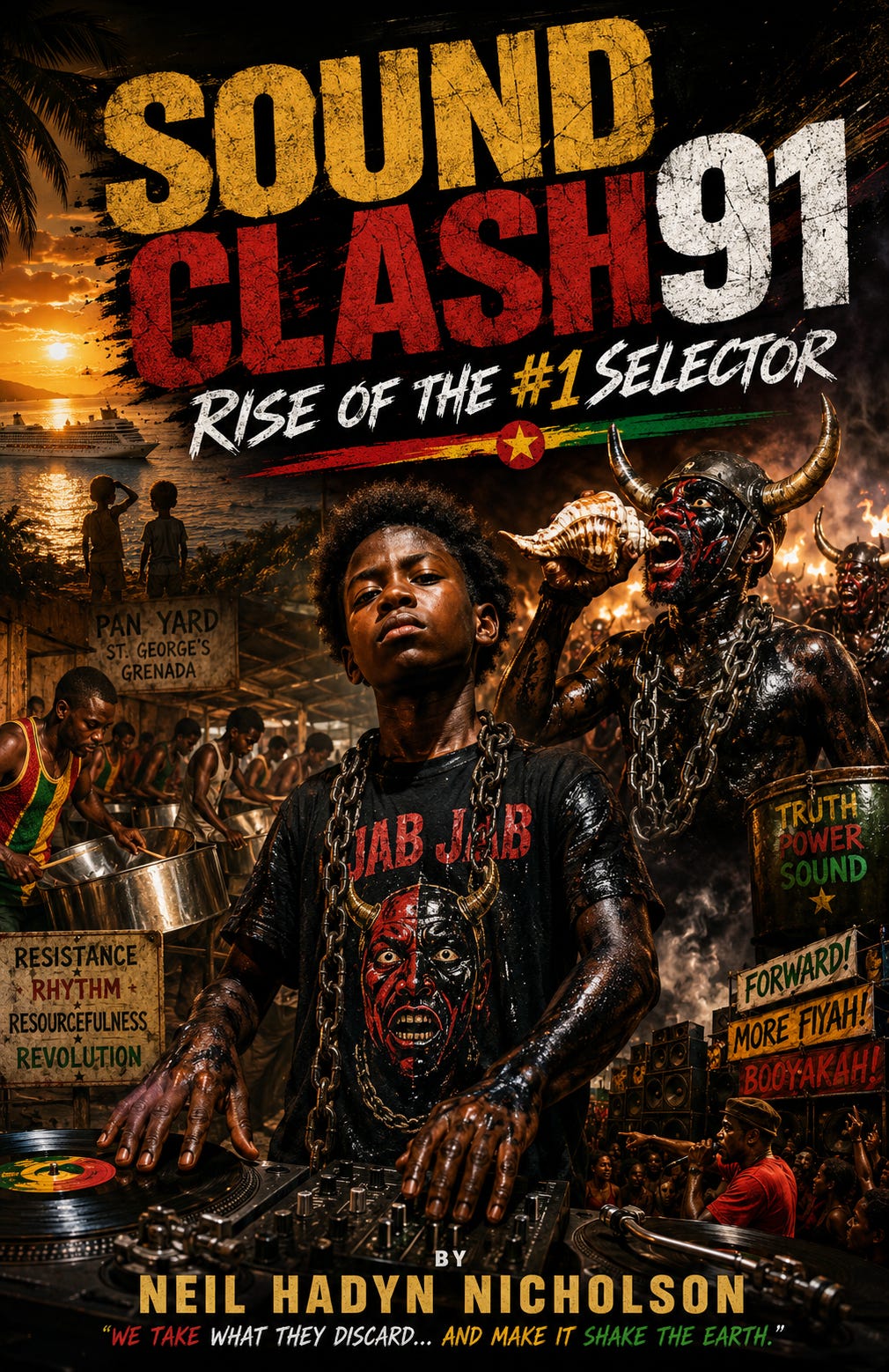
By Neil Hadyn Nicholson
From since I and I was a likkle yute, music has always played a major role in my life. My eldest brother, Natty, used to work on cruise ships and would be gone for weeks and months. We would watch the ships leaving the island as the sun shone on the water, creating a blinding streak of light. My eyes squinted, trying to keep the vessel in focus as it headed toward the horizon and disappeared beyond it.
He would leave us with strict instructions not to interfere with his record player. But when he was home, Peter Tosh and Bob Marley, Jacob Miller and Bunny Wailer, alongside Calypso Rose, The Mighty Sparrow, and Lord Kitchener created a constant movement of sweet Caribbean sounds. Reggae and Calypso music became instrumental in my musical education.
Natty, along with my other two brothers, played steel pan for different steel bands in the town of Saint George's on the island of Grenada, West Indies. My twin brother Nigel, my nephews Oral, Nkem, and Jim, and I would go and hang out at the pan yard. It was located right next to Cemetery Hill, a massive cemetery that climbed up a steep incline, the silent white headstones overlooking the explosive energy of our rehearsals.
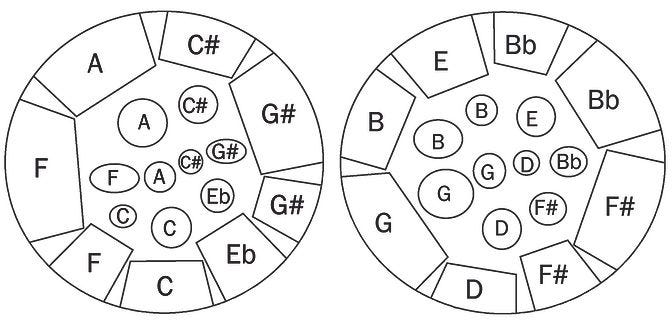
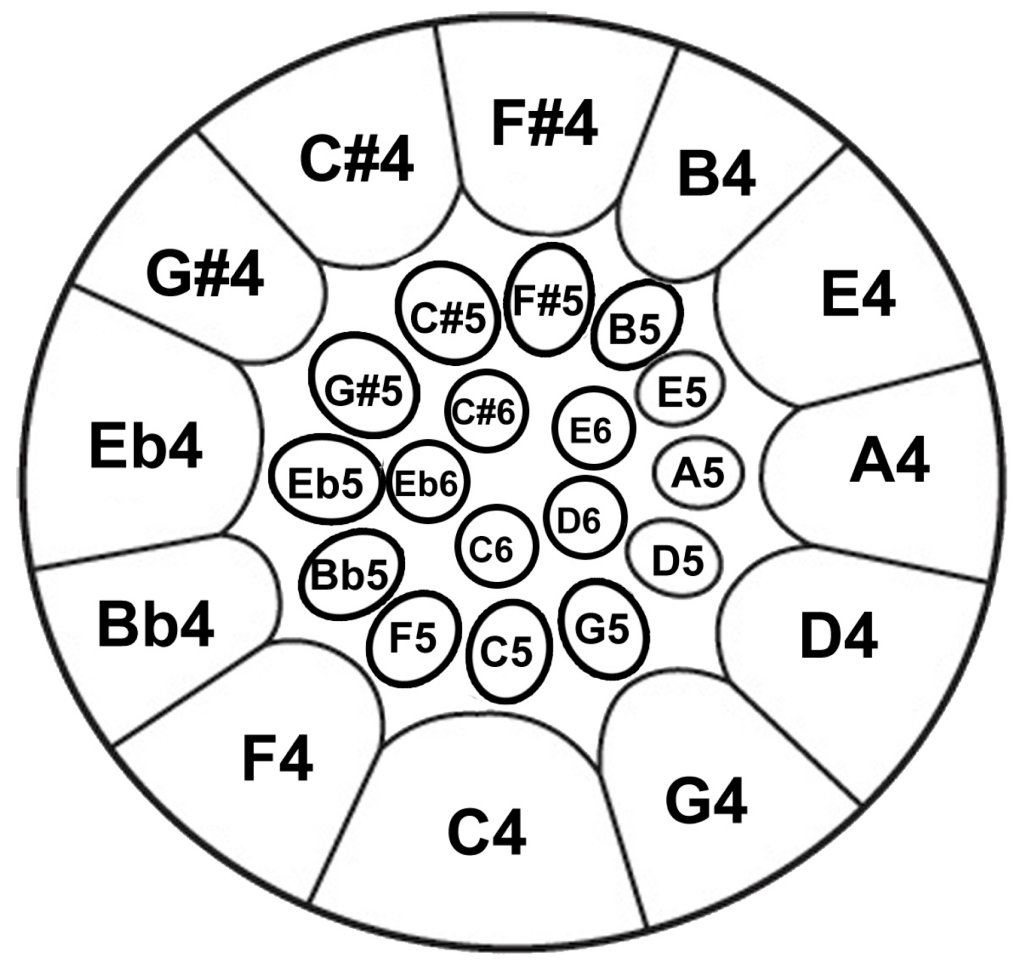
We never learned how to play the steel pan ourselves back then. Perhaps they thought we were too young and small to see over and into the instrument to find where the notes lived. To a small child, looking into the belly of a pan was like looking into a metallic labyrinth. Unlike a piano, where notes ascend in a simple, predictable left-to-right row, the tenor pan is a chromatic spiderweb based on the circle of fifths. Notes are intentionally placed across from one another to prevent cross-talk—the sympathetic vibrations that happen when adjacent notes bleed into each other. To find a simple C-major scale, a player has to skip around the circle, striking notes that face each other, dancing across the metal. Many notes have two or three octaves stacked directly inward, pulling your hands toward the deep center of the bowl.
Standing on our tiptoes, we couldn’t see that geometry. We just heard the sweet sounds of panga-langa panga-langa. The music made us tap our feet's, jump and wave and whine up. We didn't know yet that we were looking at the only major acoustic musical instrument invented in the twentieth century.
The pan was born way before our time, born out of cultural resistance and pure resourcefulness in our twin-island neighbor, Trinidad and Tobago. Our ancestors brought "talking drums" from Africa for ceremonies and communication, but after emancipation in 1834, the colonial British authorities grew terrified that freed people would use the rhythms to organize revolts. In 1884, they banned all traditional hand drums.
But you cannot kill the rhythm of the islands. Pushed into a corner, musicians in the 1930s turned to tamboo bamboo—stomping hollow bamboo sticks against the ground and striking them together to produce deep, percussive thumps. When the authorities outlawed bamboo too, claiming the sticks were being used as weapons in street gang violence, the people looked to the garbage. They began banging on everyday metal objects: dustbin lids, paint cans, biscuit tins, and old car parts, noticing that hammering the metal into raised and lowered dents produced distinct pitches.
The real revolution came during World War II. The presence of U.S. military bases and expanding oil refineries in Trinidad left behind a massive surplus of empty, 55-gallon industrial oil drums. Pioneers like Winston "Spree" Simon and Ellie Mannette looked at those discarded trash barrels and saw symphonies. Mannette figured out how to sink the tough drumhead into a concave shape and tune it to chromatic pitches, while Spree Simon created the first recognizable 14-note melodic pan. They hammered resistance, survival, and celebration right into the steel.
In the shadows of Cemetery Hill, watching my brothers' hands fly across those tuned oil barrels, I was soaking in that history without even realizing it. The pan yard was a living classroom, teaching me that music wasn't just something you listened to—it was something you claimed, defended, and built from the ground up.
Every year for as far back as I can remember, that pan yard energy built toward one thing: Carnival. It was the absolute peak of the year, a magnetic force we anticipated with a fierce, counting-down-the-days kind of hunger.
As soon as school let out for summer break, the island became our kingdom. My siblings and I filled the endless, sun-drenched weeks with a specific summer ritual. We spent our mornings making, selling, and flying kites—running up the hills to catch the wind, engaging in fierce, tactical kite battles that left the sky scarred with broken string. We spent long days losing track of time trekking to Grand Anse beach. We were naughty kids, watching the girls in their bathing suits trying to catch the older boys' attention. I was not shy; I'd make my way over to a few and sweet-talk them, but they'd shoo me away, kindly saying, “Eh eh, look at this saga boy. He cute, but we like older boys. If we meet again when you're older, and if you remember my name, who knows, eh?” I’d get a kiss on my cheek, right on the dimple. The fellas would give high-fives and I'd say she's my girlfriend, even though she wasn't. When we were not on the beach or our routine outings, Mom would always carve out a special week of every summer month for us to stay with our grandparents. Moving between our maternal and paternal homes, we were soaked in family stories, heavy plates of food, and sleeping outside under the moonlight and shining stars.
When we weren't buried in books, we were galavanting around town with restless energy. We would march down to Queens Park to press against the fences for soccer matches, or crowd into the grounds for local concerts, festive events, and traveling fairs. We made treks to the zoo and spent hours at the Tanteen playing field, a playground alive with the squeak of swings, the tilt of seesaws, and the dizzying spin of merry-go-rounds.
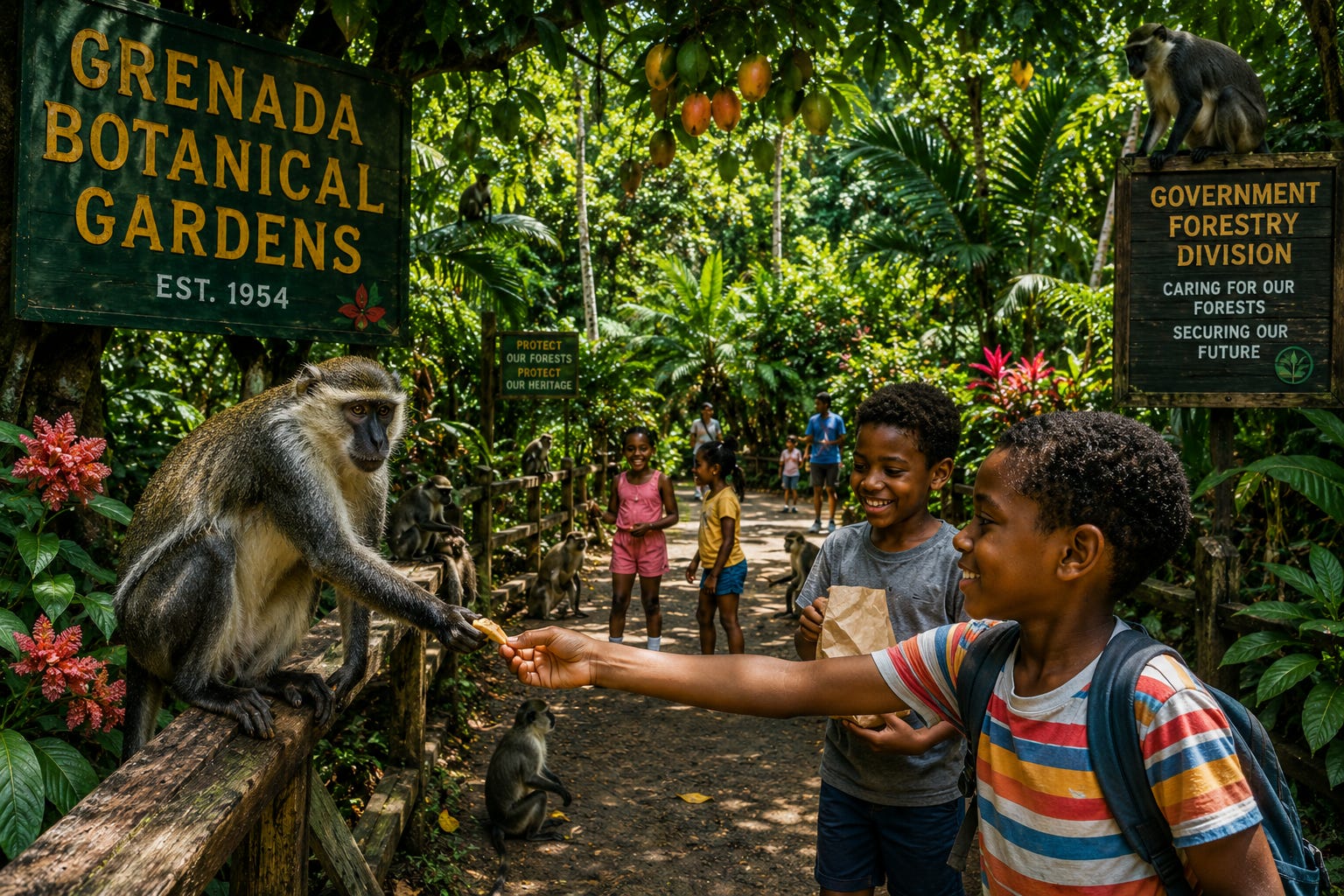
Our adventures frequently took us to the Botanical Gardens, a place that felt like a step into a wilder world. Lush, bursting with heavy fruit trees, and situated right next to the government's forestry division, the gardens were the playground of the Mona monkeys. They roamed completely free among the visitors, completely unbothered by human presence. Like the ancestors of the steel pan, these clever monkeys had been introduced to Grenada from West Africa back in the eighteenth century, adapting perfectly to the Caribbean soil. They knew exactly how lush the property was, and they would boldly hang around the pathways, using their charm to hustle snacks from passing visitors.
In the summer, the island felt more alive than any other time of year. Visitors flocked from all over the globe, the blue waters filling with sails for the yacht club regatta races, while swimming competitions pushed athletes around the coast. But no matter where the sun took us during the day, when late evening reached, the gravity of the music pulled us right back. We’d find ourselves resting in the dirt of the pan yard, watching our family members hone their steel pan skills, mastering complex arrangements and musical compositions with an ease that looked like magic.
Right next to almost every steel band on the island was a Mas camp. There, costume designers and makers worked in perfect sync, their hands flying through feathers, wire, and cloth to create beautiful, lavish costumes and towering floats for the road march competitions.
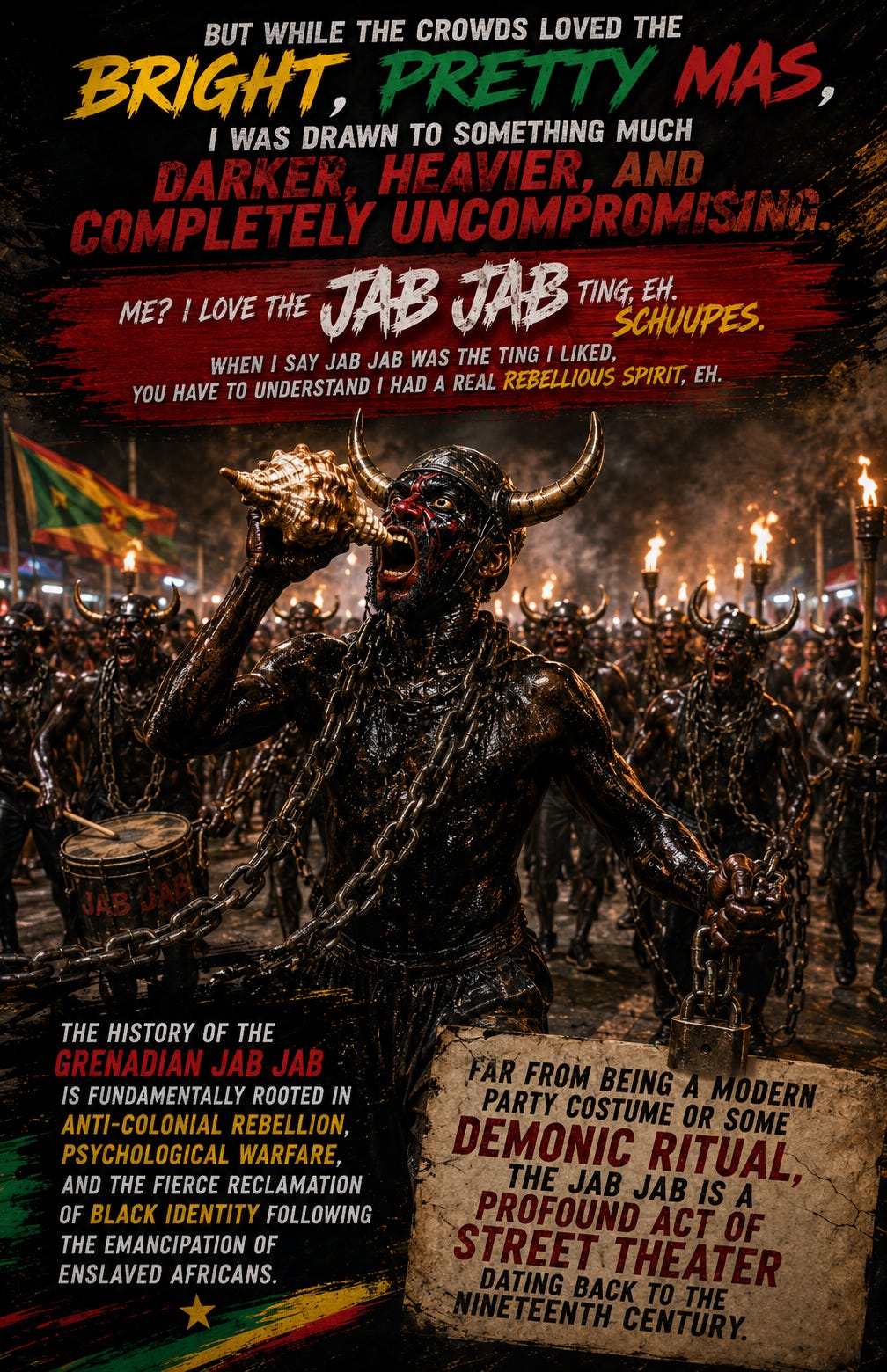
But while the crowds loved the bright, pretty mas, I was drawn to something much darker, heavier, and completely uncompromising. Me? I love the Jab Jab ting, eh. Schuupes. When I say Jab Jab was the ting I liked, you have to understand I had a real rebellious spirit, eh.
The history of the Grenadian Jab Jab is fundamentally rooted in anti-colonial rebellion, psychological warfare, and the fierce reclamation of Black identity following the emancipation of enslaved Africans. Far from being a modern party costume or some demonic ritual, the Jab Jab is a profound act of street theater dating back to the nineteenth century.
The term itself comes from the French patois diable, meaning devil. Under colonial rule, European masters and missionaries routinely demonized African cultural traditions, spiritual practices, and Black skin itself. When emancipation finally came in 1834, the newly freed people took that racist rhetoric and turned it into a razor-sharp weapon of satire. Their attitude was beautifully defiant: "You call me a Black devil? Fine. I will show you the ultimate devil."
When the Jab Jab take to the streets during the early, pitch-black, pre-dawn hours of J'Ouvert Monday to open Spicemas, every single visual element is a living historical reference to the horrors and survival of the plantation era. Originally, masqueraders used molasses, charcoal dust, or raw tar from the sugar estates to coat their entire bodies. By my time, we used stale motor oil, painting ourselves until we shone like midnight. This blackening was both a mask for anonymity and a proud, amplified celebration of beautiful, unified Blackness.
On our heads, we wore helmets affixed with protruding cow or bull horns, deliberately parodying the Christian "devil" imagery enforced by our former oppressors and weaponizing it as an ancient form of rebellion. We painted our mouths blood-red, a visual tied deeply to West African warrior folklore, mimicking traditions like those of the Mursi people who painted their faces before going into battle.
As we marched, we dragged heavy steel chains and padlocks down the asphalt. In the past, those links were the literal tools of our physical captivity; dragging them through the modern streets became a symbolic act of breaking out of oppression, shedding the historical burdens of our ancestors.
The Jab Jab procession isn't chaos—it is a deeply organized, hypnotic collective. Led by commanders known as Capitals, who direct the throngs using sharp, piercing call-and-response chants called "spellings," the mass moves forward as a unified wall of sound. There are no sweet melodies here. The rhythm is driven by a steady battery of bass, coupé, and cutter drums, punctuated by the haunting, primal roar of blowing conch shells—the exact sound historically used to signal slave revolts across the Caribbean.
Other islands have their variations, like the Jab Molassie, but Grenada is globally recognized as the spiritual home where this massive, uncompromising Jab Jab culture was born and fiercely preserved. It is a living lineage that shifts the definition of "the devil" off the masquerader and casts it right back onto the oppressive systems of history.
Covered in black oil, the heavy steel chains rattling against the ground, and the conch shells screaming into the early morning air, that rebellious spirit inside me found its home. I wasn't just a boy playing a character in the street. I was stepping into a long line of selectors, warriors, and rebels who knew how to take the heavy, discarded pieces of history and make them shake the earth.
Because performance is big in dancehall culture, and your presence as a selector is much more than just a person spinning records. It involves theatre, deep theatrics; it is a live monologue play. You speak directly to the audience and directly to your opponents. When you introduce a song or a heavy dub plate special, you aren't just dropping a needle—you are telling the story behind it, commanding the room and drawing every soul into your circle.
It is a war of music. You kill your opponents by selecting the absolute best songs to trigger the loudest, most primal reactions: screams, whistle blowing, hand horns, and thunderous shouts of forward, more fiyah, and booyakah booyakah! You get the crowd so hype, so completely intoxicated on the rhythm, that they invest their entire attention into you. They forget you even have opponents on the stage. In fact, by the time you're through with them, they don't even want to hear the other side, and loud, jarring boos fill the dancehall the second your rival tries to speak.
That was the power I wanted. That was the theater I was preparing for. From the strict rules of Natty's record player, to the hidden geometry of the pan yard, to the motor-oil defiance of the Jab Jab, everything had been leading to this.
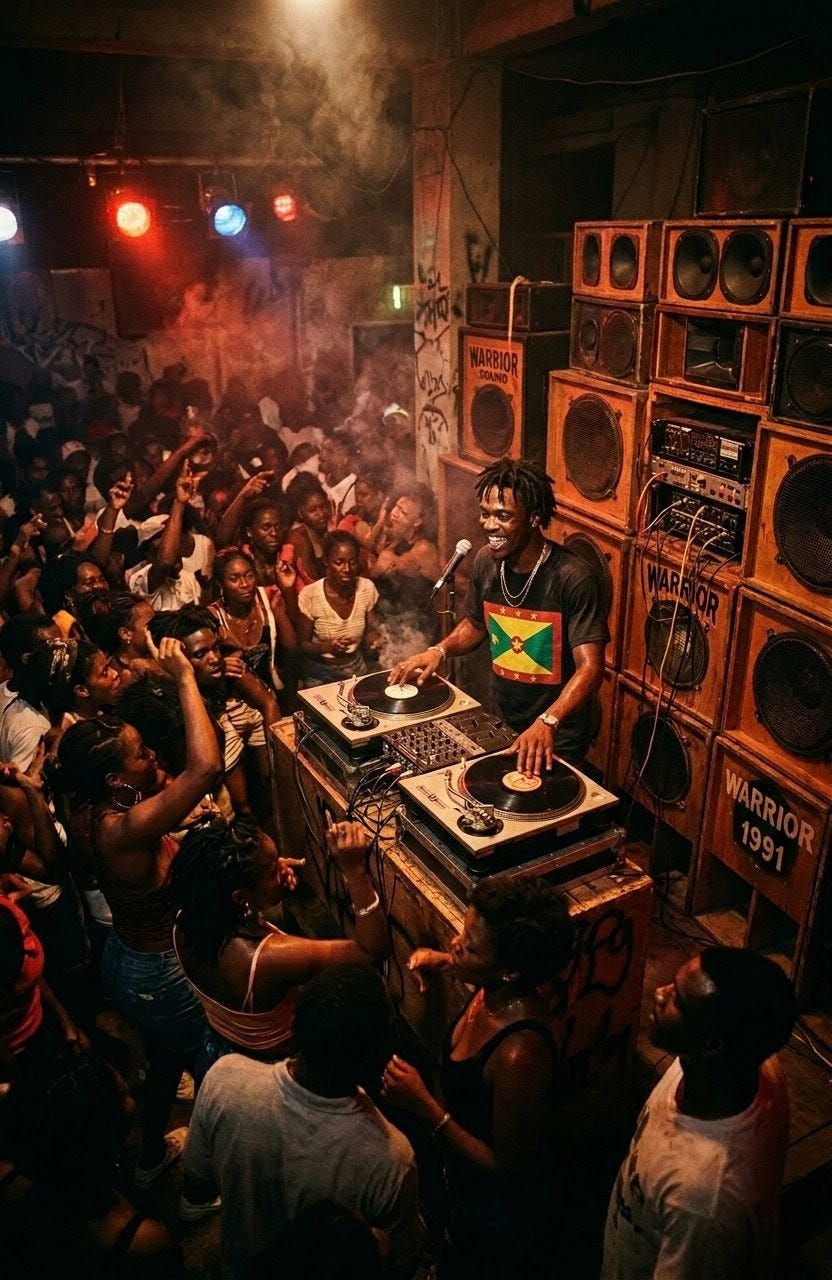
The year was 1991. The dancehall was packed, the air was thick with smoke and anticipation, and it was time for the rise of the #1 Selector.
To Be Continued 🫶🏿🇬🇩